
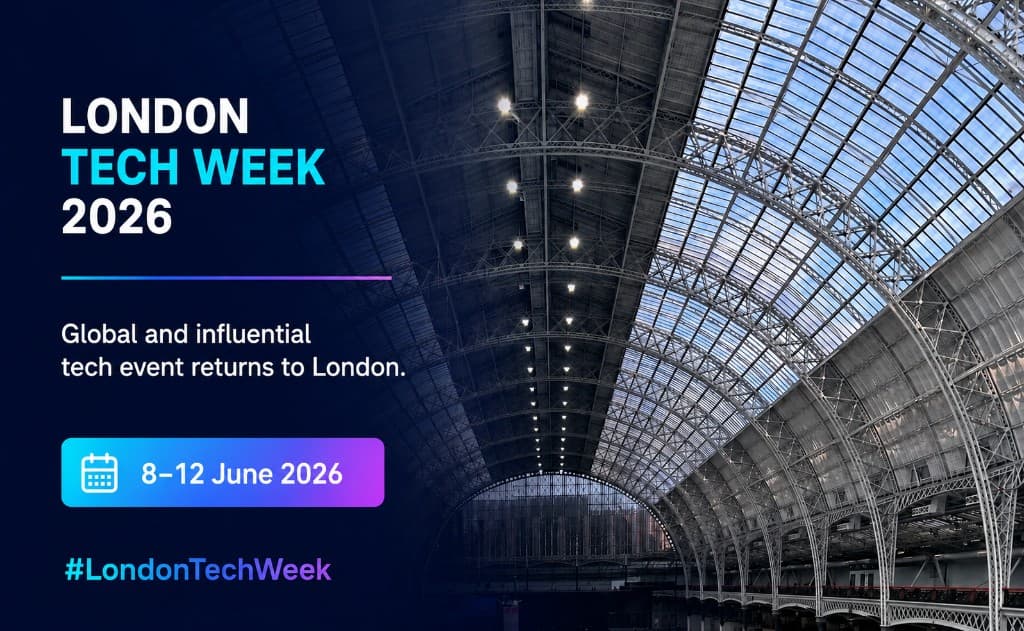
London Tech Week 2026: Europe’s Capacity to Build, Own & Govern the Infrastructure of AI and Keep Pace
Europe's largest technology festival closes with billions pledged, hard questions posed, and a continent that appears to have finally moved from ambition to urgency.
London Tech Week 2026 ended on Friday having done what its organisers promised and something more besides. The three-day conference at Olympia London — now in its 13th year — opened with a prime ministerial keynote and a cascade of investment announcements totalling more than £4 billion. It closed having surfaced a harder, less comfortable question: whether Europe's capacity to build, own and govern the infrastructure of artificial intelligence can keep pace with the scale of its stated ambitions.
The UK technology sector was valued at £1.2 trillion in 2026, according to new data released by Tech Nation on the opening day, with UK AI startups raising more than £8.2 billion in venture capital in the first half of the year alone. Prime Minister Sir Keir Starmer, who opened proceedings at Olympia, used the occasion to announce a national AI compute strategy anchored by £400 million in public funding to purchase sovereign AI compute capacity — framed explicitly as a means of allowing British firms to start, scale and stay in the country rather than relocate for cheaper hardware abroad.
The private sector followed. AMD committed up to £2 billion over five years, earmarked for high-performance compute infrastructure with the University of Cambridge, R&D with Imperial College London, and direct investment in UK startups. Nebius committed approximately £1.7 billion, funding three new deployments of Nvidia infrastructure scaling to 65 megawatts of capacity by 2027, and expanding its commercial and AI research hub in London. Mayor of London Sadiq Khan added a £12 million AI adoption package for small and medium-sized enterprises, administered by London & Partners at £4 million annually over three years.
The headline number was eye-catching. The context behind it drove the week's most consequential debates.
The Sovereign AI Question
Day one in the AI Arena centred on European competitiveness and what organisers described as a growing case for sovereign AI. The framing was deliberate. Sessions covered AI infrastructure, foundation models and governance frameworks designed to reduce dependency on US or Chinese platforms, linking those topics directly to enterprise adoption and large-scale implementation.
George Osborne, Managing Director and Head of OpenAI for Countries, appeared in the AI Arena panel on sovereign AI development in Europe — a casting choice that underscored the tension at the heart of the discussion: the most prominent voice for European AI independence sitting alongside a representative of one of the American platforms that European sovereignty arguments are, in part, directed against. Sessions on sovereign AI addressed the establishment of independent governance frameworks and the development of indigenous AI models, framed as critical tools for reducing Europe's reliance on external platforms.
The consensus that emerged was less a roadmap than a shared acknowledgement of the stakes. The debate has moved on from long-term ambition to near-term decisions: where compute sits, who controls critical infrastructure, and how organisations can adopt AI at scale without becoming strategically dependent on a small number of global platforms. Carolyn Dawson OBE, CEO of Founders Forum Group and the event's lead organiser, called it the most important edition in the conference's history. "Europe has entered a decisive decade for technology, one where the outcomes are not guaranteed," she said.
The Scale Problem
Across the exhibition floor in Startup World, the Deep Tech Stage addressed a related but distinct challenge: the UK is producing some of the world's most exciting deep tech companies across quantum computing, AI, robotics, biotech and clean energy — but the challenge is no longer invention. It is scale.
The Building Europe's Deep Tech Backbone session drew some of the sharpest voices on the programme. Investor representation came from Erin Hallock of the NATO Innovation Fund, the world's first multi-sovereign venture capital fund backing defence-relevant deep tech startups, and Dr Hermann Hauser KBE of Amadeus Capital Partners, the co-founder of ARM. The diagnosis they offered was familiar but no less pressing for being so. The real question, as framed by speakers and investors alike, is whether Europe can build and finance companies in strategically important fields, or whether it will continue losing talent, intellectual property and commercial value to larger markets.
Europe's defence and industrial ambitions, it was noted, require faster adoption of deep tech, new procurement models and cross-border collaboration — yet too often, key technologies develop in isolation, failing to scale because the continent's innovation ecosystem remains fragmented.
Quantum's Moment — and Its Limits
The most forward-looking session on the Deep Tech Stage asked whether quantum computing would be the driving force behind the next wave of AI breakthroughs. The answer, from a panel that included Sir Peter Knight, who chairs the UK's National Quantum Technology Programme and oversees a £2.5 billion government commitment including the £2 billion ProQure procurement programme announced in March 2026, was carefully hedged.
Quantum's near-term contribution to AI, panellists argued, lies not in replacing classical computation but in augmenting it. Hybrid classical-quantum architectures are advancing faster than most enterprise AI teams have priced into their planning cycles, with quantum error correction in particular moving closer to practical thresholds. The longer-term case — quantum-accelerated model training, combinatorial optimisation at scales beyond classical reach — was accepted as real. The dispute was over timing, and over who would control the infrastructure when it arrived. The UK's ProQure programme was cited as an example of a government trying to answer that second question before the first one is fully resolved.
Infrastructure and Its Discontents
The most grounded discussion of the week came on the AI Arena's third day, when the conversation turned to the physical limits of AI data centres and what comes next. The session was in some respects a corrective to the investment optimism that had characterised the opening. Reducing dependency on foreign technology infrastructure was not treated as an abstract policy preference but as a conversation about who owns the physical layer of AI — the land, the power, the cooling, the silicon.
Panellists described a build-out trajectory for hyperscale data centres that is encountering real constraints: energy grid capacity, planning timelines, water usage and the sheer capital intensity of the next generation of compute. The debate moved through the alternatives — distributed compute architectures, edge inference, liquid cooling advances, and the role of small modular reactors in powering AI at scale — without landing on a single solution. What emerged instead was a clearer shared understanding of the problem: the current model of centralised AI infrastructure has a ceiling, and the industry is approaching it faster than the policy frameworks designed to govern it.
The Broader Picture
AI commanded the biggest platform — the AI Arena ran across all three main conference days — but the new Deep Tech Stage carved out dedicated space for sectors that tend to get overshadowed at AI-dominated conferences. That structural choice, separating applied AI from the longer-cycle science beneath it, reflected something real about where the European technology debate currently sits: broadly fluent in AI's near-term commercial applications, considerably less certain about the deep infrastructure questions that will determine who benefits from them.
"This is the most important London Tech Week we've ever hosted," said Dawson. "Our focus for the week is clear: how AI is transforming industries and outcomes, building resilience through tech sovereignty, and the next frontier of deep tech, amid what is undoubtedly Europe's decisive decade."
Whether that decade ends in European technological leadership, or in a more familiar story of world-class science that failed to scale, is the question the week raised and left, appropriately, unanswered. London Tech Week 2027 will have something to measure it against.
London Tech Week 2026 ran from 8–10 June at Olympia London, with fringe events across the capital through to 12 June. The AI Summit at Tobacco Dock followed on 10–11 June.